You’re in a meeting. Someone asks you a question, and the whole room turns toward you.
You know you know the answer. You can almost feel the thought sitting there, but it’s taking longer than it used to to gather the words and line them up. The room is waiting. Everyone seems patient. You’re the one who notices the pause.
Before the concussion, this was easy. Now you leave the meeting frustrated, wondering why something that used to feel automatic takes so much effort. You may look fine from the outside. Inside, you don’t quite feel like yourself.
If that moment feels familiar, you’re not imagining the change. “Brain fog” is a common way to describe slowed thinking, trouble finding words, difficulty concentrating, or feeling mentally overloaded after a concussion. It’s real, but it isn’t one single problem with one explanation.
What does brain fog after a concussion feel like?
People use “brain fog” to describe different experiences. You might lose your train of thought, need longer to answer, struggle to switch between tasks, forget why you walked into a room, or find that reading and screen time drain you faster than before.
Concussion can affect attention, processing speed, learning, memory, and executive function. These changes can interfere with work, home life, and social activities. A focused conversation about what happens, when it happens, and what it gets in the way of can be more useful than the broad label alone.
Why can brain fog continue after a concussion?
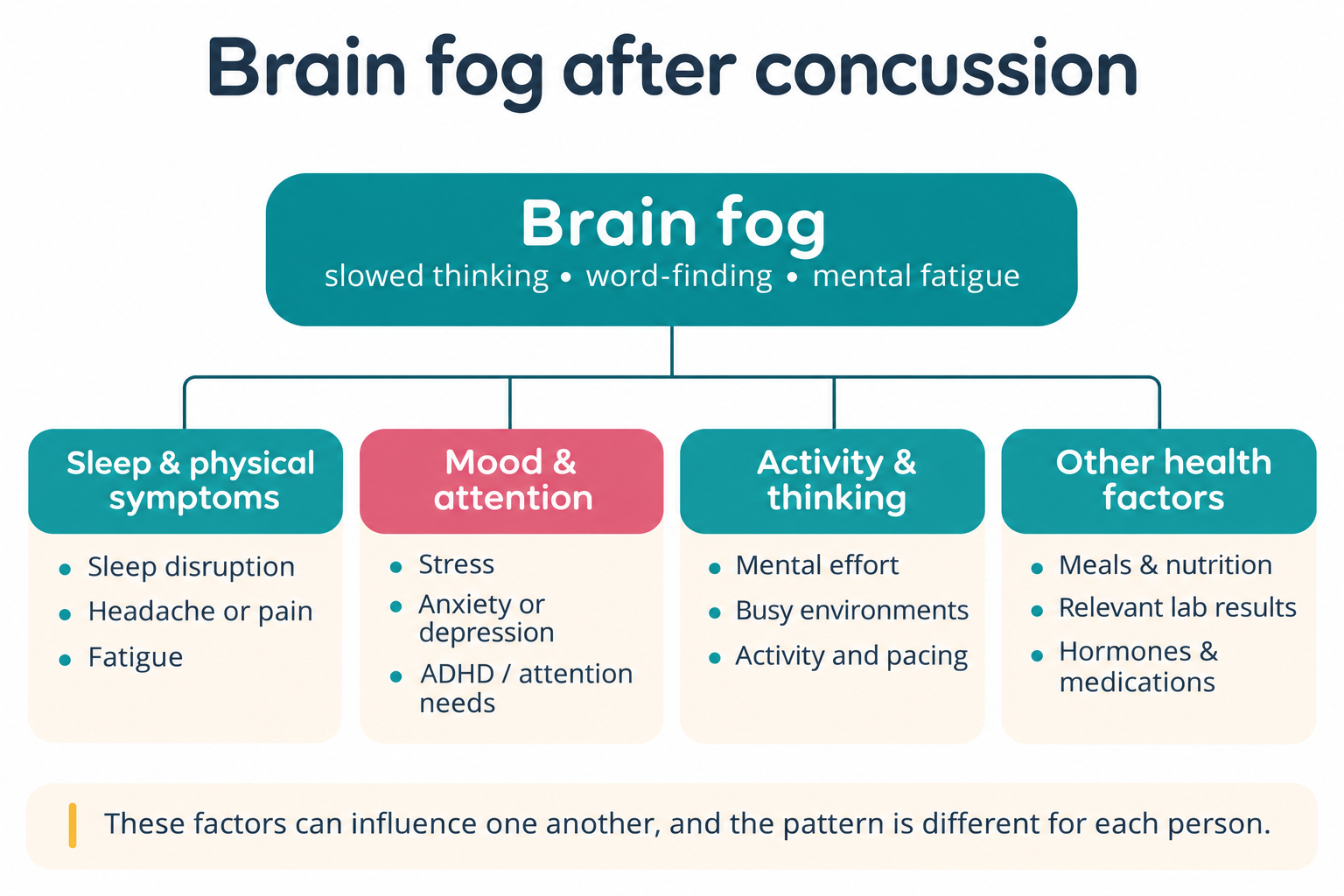
Concussion can affect thinking directly. But persistent cognitive symptoms can also be shaped by other difficulties that often occur alongside concussion, think things like headache, poor sleep, pain, fatigue, and changes in mood. These factors can overlap and amplify one another.
The brain and the rest of your health are working together, and it makes sense to look at all the contributing factors. We want to ask not just “What is wrong with my memory?” but also, “What is making it harder for my brain to do its job right now?”
Can poor sleep or headaches make brain fog worse?
Quick answer, Yes, they can. A night of fragmented sleep can leave anyone less alert. After concussion, ongoing sleep disruption may add to fatigue, mood changes, pain, and difficulty concentrating. Headaches and neck pain can also steal your attention. It’s hard to follow a conversation or hold a thought in mind when part of your focus is occupied by pain.
Notice whether your thinking changes after a poor night, during a headache, or when pain builds. Those patterns don’t prove one cause, but they can help your care team choose a place to start. Concussion guidelines prioritize sleep, headache, and mood in part because they can affect other symptoms and participation in rehabilitation.
Can anxiety, depression, stress, or ADHD be part of the picture?
Yes, Anxiety, depression, and sustained stress can affect attention, working memory, sleep. Worrying about your symptoms or about returning to work can add another layer of cognitive load. Addressing mood or stress doesn’t mean the concussion doesn’t matter. It means these experiences can influence how difficult thinking feels and what kind of support may help.
ADHD can matter too. If attention differences were present before the injury, concussion-related fatigue, sleep disruption, pain, or sensory overload may make familiar strategies less effective. Sometimes the changed demands after an injury make previously manageable attention challenges much more visible. That’s different from assuming a concussion caused ADHD. While cognitive symptoms after concussion can look like ADHD, ADHD is something people are born with, your can’t develop it later in life. A clinician can help sort out what was present before, what changed after, and whether your supports still fit.
Can doing too much bring on brain fog?
Sometimes the fog appears after a long meeting, a busy store, a screen-heavy day, or trying to finish several demanding tasks without a break. Cognitive and physical activity both take energy. If symptoms reliably build with activity, the timing and recovery afterward can help show where your current capacity is and whether your day needs pacing, adjustments, or a gradual plan to build tolerance.
This isn’t a reason to avoid all activity indefinitely. Concussion guidance generally supports a gradual return to activity, adjusted to symptoms and individual needs. The aim is to find a level you can repeat and build from, with your care team’s guidance, rather than repeatedly pushing until you crash or stopping everything because symptoms appeared once.
Could meals, blood sugar, or nutrient levels affect concentration?
They may be relevant parts of the overall picture, especially if you’re skipping meals, eating less because of nausea or fatigue, or noticing that long gaps without food leave you drained or less focused. Regular access to nourishing food and fluids is a practical foundation.
Depending on your history and symptoms, a clinician may also consider whether testing for issues such as iron deficiency, low vitamin B12 or vitamin D, or thyroid dysfunction is appropriate.
Can hormones or medications contribute to brain fog?
Hormonal changes, including those related to menstrual cycles, perimenopause, or other endocrine conditions, may affect sleep, energy, mood, headaches, and concentration for some people. Many of our hormones are regulated through the brain so it makes sense that hormones can be disrupted post-concussion. The good news is that most hormones, even if they are disrupted, return to baseline in the weeks and months following an injury.
Medications and supplements also deserve a review. Some can affect alertness or concentration, and the overall combination may matter. Don’t stop a prescribed medication on your own; bring the full list, including over-the-counter products, to the clinician who can review benefits, timing, side effects, and alternatives with you.
How can I figure out what is driving my brain fog?
Look for patterns rather than trying to solve everything at once. For a week or two, jot down a few details when the fog is noticeable:
What were you doing?
How long had you been active?
How did you sleep the night before?
Were headache or pain present?
Had you eaten recently?
What was your stress or mood like?
How long did it take to recover?
Keep it simple. The aim isn’t to monitor yourself perfectly; it’s to notice connections.
A clinician may ask what you’re trying to get back to, which tasks are hardest, what makes symptoms worse, what helps, and what your day looks like now. They may review sleep, headaches and neck pain, mood, activity tolerance, medications, nutrition, health history, and whether targeted examination or testing makes sense. When cognitive symptoms are significantly limiting or persist, a more specialized cognitive assessment may also be considered.
What can I do while I’m waiting for answers?
Use supports that reduce the amount your brain has to hold at once. In a meeting, ask for the agenda in advance, keep notes, request one question at a time, or give yourself a moment to think before answering. At work, written instructions, fewer interruptions, planned breaks, and a gradual increase in complex tasks may help.
Keep a steady sleep and meal rhythm where possible, and pace demanding tasks so you’re not stacking every difficult thing into one stretch. If symptoms are changing, worsening, or not improving, follow up with a health professional.
What if I don’t feel like myself yet?
The pause in the meeting can feel small to everyone else and enormous to you. It can interrupt confidence, work, and the sense of being the person you were before. It’s important.
You don’t have to decide on your own whether the answer is “just rest,” “just stress,” or “just the concussion.” Brain fog is real. It can have several contributors. Understanding the pattern gives you and your care team more useful questions to ask and more possible places to begin.
If ongoing symptoms are affecting your work or daily life, you can book a complimentary 15-minute concussion care strategy session with Dr. Katie Thomson Aitken, ND. It’s a chance to ask how individualized naturopathic care works and whether it may fit alongside your current care team.