
Elimination Diet Dinners - Week Two Recipe Links
Hope your first week is going well! Mine is well.. going. I miss coffee and while I thought I had mastered the art of not being hungry on an Elimination Diet, the extra calories I'm loosing through breastfeeding have been a little harder to pick up, making me realize I was topping up with some empty calories. Time to pick up the smoothies I guess! On the plus side my skin is feeling great!
Here are the links and/or recipes for this weeks dinners! Enjoy!
Roast Salmon
Again, this week starts out with a roast dinner from Jamie Oliver. I love doing this because it's simple, it looks nice on the table, and you get great leftovers for meals later in the week. This week's roast is for a Roast Side of Salmon. The recipe has some veggies along side it but feel free to use your own family favourites.
Veggie Korma with Mock Cauliflower Pilau
I'm so excited about this curry because it's such a hit at my house. It's something I pull out when I feel like my daughter hasn't been eating enough vegetables because, since it's all vegetables, she's bound to get some in. I usually cook it out of "Save with Jamie" but I found this really cool PDF that even has pictures!
I wanted to let you know that I usually change a couple of things. First, if you are on the elimination diet you do want to leave out the optional feta cheese (and the yoghurt). Second, I don't like to use the liquid from canned beans (or the cooking liquid from beans) because it reduces the gas-causing carbohydrate raffinose in the final dish. Lastly - and this one is 100% optional - but my family is not 100% on board that cauliflower is a replacement for rice. In order to convince them (that sounds better than trick them right?!?!) I make "fancy rice". This means melting some oil / butter / ghee in a large pan, adding some flavours (such as lemon zest and juice, ginger root and turmeric) and then stirring the cooked rice through the yummy flavours.
Chicken Curry
This is another one of my fav's from Donna Hay's cookbook The New Easy. As much as I like cooking it's nice to have a curry recipe you throw in the oven and forget about! This is that one.
Lamb Tagine
This is another recipe from Gwyneth Paltrow's "It's All Good." Lamb is an allowed red meat on the Elimination Diet as it is generally still raised grazing on pasture and is therefore less inflammatory a red meat choice. While some individuals do well on no red meat, many people require meat in their diet (and occasional red meat) to feel their best. I'm one of those people so there's a bit of lamb in my menu plan. This recipe has some preserved lemon on top; I generally don't have preserved lemon on had so I just leave them out (it's still good).
Fish Burgers
I love these salmon burgers. The pickled ginger and cilantro go so well with salmon! They do have a bit of a challenge with them which is that they fall apart if you ignore the part where they are supposed to rest in the fridge. Now - normally something like that is enough for me to ignore a recipe forever but these are really yummy and on an elimination diet - I need healthy food that is really yummy. So it's best to suck it up and prep these the day before, then when you get home from work its really easy to just cook up the burgers and steam or sauté the vegetables. Make sure to make enough for lunch the next day - you are going to want to eat them again.
Chinese Chicken Salad
I hate to say this, but if you hate salads you are probably making them wrong. This one is a prime example of how to do one well - so you'll actually want to eat it. It has a soft and a crunchy lettuce, extra veggies for sweetness and texture, lots of herbs, a seed, some protein and a killer homemade dressing you'll want to use over and over again. This version has poached chicken breast - just for the salad, but it also works well with leftover roast chicken (or one of those grocery store rotisserie chickens. Shhh.)
Chicken Burgers
Making your own burgers is a sure fire way to avoid additives like gluten and soy as well as preservatives. It's also a great way to add in fun flavours and make the burgers you want to eat. I really love these chicken burgers. Keep them elimination diet friendly by pairing them with steamed our sautéed bok choy and some brown rice. Finished your elimination diet? Try them at your next BBQ on a bun with mayo.
Check back next week for new recipes!
Elimination Diet Dinners - Week One Recipe Links
Happy Elimination Diet! These foods are things I love to eat ALL the time (whether I'm on an elimination diet or not!) I hope you LOVE these recipes as much as my family does!
Roast Chicken
My default for all roast dinners is the fabulous Jamie Oliver. He really gets family cooking and his recipes are often easy to learn and nutritionally sound. This roast chicken dinner is something I've been cooking forever and I'm sure it will become a regular at your house.
Vegan Shepherd's Pie
Is it a shepherd's pie if it's vegan? I'm not sure it is but this lentil dish is too good to leave out.
Kale and Cashew Pesto Pasta
This is one of my fav's from Donna Hay's cookbook The New Easy. True to it's name this cookbook is full of modern flavours in recipes that are incredibly easy. In this version I'm swapping out spaghetti for this really cool pea pasta I found at Costco. It's gluten free and has way more protein than wheat pasta! Plus it has the best texture of any gluten free pasta I've tried to date.
Ingredients
4 servings pea pasta
1/2 bunch of kale
1/3 cup parsley
1 clove garlic
2/3 cup cashews
1 lemon
1/2 cup olive oil
Instructions
Cook the pea pasta according to package directions. While pasta is cooking prepare pesto. Chop kale and parsley in a food processor. Add garlic, lemon zest, cashews, and olive oil and pulse until finely chopped and combined. Toss the pesto on the pasta and serve with lemon wedges.
Chicken Tray Bake
I love this dinner because it's easy to prepare and it's so yummy - it seems like it should be more complicated but the oven really does all the work. What I like about this tray bake is that it's free of pre-made condiments but it still tastes really great.
Roasted Trout
Trout is one of my favourite fish to eat. It's full of the long chain omega-3 fatty acids we all need more of, it's local to Ontario lakes, and it's usually quite affordable! One of my first blogs was a trout recipe, I hope you like this simple recipe for weeknight trout!
Cashew Chicken Satay
This is the kind of fun food I want to eat on a Friday night. Tasty, fun and it doesn't take too much brain power to put together. I often serve it as part of "dip-able dinner" with some chopped raw veggies. Check it out.
Check back next week for new recipes!

How to Drink at a Holiday Party
Hey! It's December and that means it's time to CELEBRATE. If your celebrations are anything like mine that means that there is occasionally alcohol at them. Did I say "occasionally alcohol"? I meant "often wine." But if you were hoping for a list of tasting notes I'm sorry to disappoint! This how to guide is a little less "how to indulge" and a lot more "how am I going to manage my health risks since I'm for sure having some wine"
Hey! It's December and that means it's time to CELEBRATE. If your celebrations are anything like mine that means that there is occasionally alcohol at them. Did I say "occasionally alcohol"? I meant "often wine." But if you were hoping for a list of tasting notes I'm sorry to disappoint! This how to guide is a little less "how to indulge" and a lot more "how am I going to manage my health risks since I'm for sure having some wine" Its a practical conversation that often gets over looked. And while most of us know that alcoholic beverages are not health tonics **spoiler alert** alcoholic drinks are not health tonics, it's hard to keep things in "moderation" when you have no objective information as to what moderation even means! So here is my guide on how to drink at a holiday party, while minimizing your health risks from alcohol, and still having a good time.

The first thing is you have to do your homework and understand what moderation *actually* is. For men, the Canadian recommendations for harm reduction are a maximum of 15 standard drinks per week, with no more than 4 drinks on one occasion. For women the recommendations are slightly lower at 10 and 3. While 3-4 drinks is nothing to shake a stick at if you start early (Hello coffee and Baileys!) or go late, (Hello, coffee and Baileys? Again?) it can be easy to slip past these harm-reduction guidelines. So here are my real-life party guidelines for having a good time and staying safe.
Pre-Party Drinks
When your looking to be responsible about drinking it’s best to pass on the drink before you even leave the house. Yes having a beer while you wait for your partner to get ready seems like a great idea or maybe you want a glass of wine while you are doing your hair but when striving for moderation save your drinks for the main event.
Cocktail Hour
If you’d like a spirit, have one! But make sure it’s a measured drink. For spirits, 1.5oz counts as one drink. It doesn’t really matter if you’d rather sip a gin martini or mix it with tonic as long as it’s 1.5oz of booze it counts the same. Sometime people reccommend mixed drinks over straight spirits because if it takes you longer to drink a higher volume you are less likely to drink more over time. I think thats pretty terrible advice though as I know lots of people that drink a GandT way faster than a 1.5oz martini! In the end, as long as it's measured, it's the same amount of alcohol. If you finish your drink and cocktails are still flowing, choose an alcohol free option. Filling your rock glass with tonic water and a lime is a great way enjoy the ambiance with out the alcohol. Also sparkling water is a festive choice.
Dinner
If you are sitting down to dinner there may be wine or beer offered with the meal. Again, if you would like to partake, enjoy, but best to keep track of how much you are drinking. One standard drink of wine is 5oz, which if you measure at home, you may find to be quite a bit smaller than your standard pour. Also be careful of the top ups! Some hosts consider it a personal mission to stop wine glasses from ever becoming empty, but this makes it impossible to know exactly how much you've consumed. Be on guard and don’t let an over zealous host happen to you! Decline any refills to your wine glass until it is truly empty - otherwise you will have no idea how many glasses you’ve really had.
If you are drinking beer, be aware that serving size depends on how much alcohol is in your beer. A serving of regular beer (5% alcohol) is 12 oz (a bottle), where as a strong beer (7%) counts as a serving at only 9 oz, less than a full bottle. Choosing lower alcohol choices in both size of drink and % alcohol can be helpful to keep drinking within moderation guidelines.
Dessert / After Dinner Drinks
Depending on the party, the drinks may not end with dinner. There may be a digestif or special after dinner drink. People may just still be enjoying wine or beer. Remember to alternate alcoholic with non-alcoholic drink choices and consider choosing an after-dinner coffee or tea instead.
Driving
This is an obvious but important point. If you are going to enjoy a few drinks (even in moderation!) it is imperative that you DO NOT DRIVE. Drinking moderately is not the same as safe to drive and it’s important not to confuse the two.
Seem like too much to ask? If you would like help cutting back your drinking find out how naturopathic medicine can support you! Book your complimentary consultation today.
Let's Talk About Preventing Suicide
When it comes to suicide prevention, I think, because this topic is so stigmatized, that many people think "this isn't going to happen to me" or that their friends and family aren't affected, but I'm sure that's really not true. How likely is it someone will confront someone with suicidal thoughts?
It's so true that many people think suicide or thoughts of suicide is something that happens to "other people." That's what I thought before life taught me that simply isn't true. Suicide is not a mental illness; it's a mental health issue. There's a difference...
It's November! This year celebrates 10 years of "Movember" in Canada and gives us another great opportunity to talk about a health concern that disproportionately takes the lives of men, suicide. While not always easy to talk about suicide, this threat is out there and it is real. To help address this concern I've invited a local expert, Shawna Percy, to answer some questions about suicide prevention.

Shawna is the Founder of Life Voice Canada.
Life Voice specializes in building suicide-safer communities through suicide prevention workshops such as safeTALK, ASIST, and "ASK" (Assessing for Suicide in Kids 5-14). Bereaved by suicide Shawna knows the impact of suicide from both a head and heart level. In her TEDxUW talk "Suicide in Preventable" Shawna explores what we can do to help those at risk of suicide help themselves stay safe. You can learn more about Shawna and Life Voice @LifeVoiceCanada on social media, or at www.LifeVoice.ca
Prevention
When it comes to suicide prevention, I think, because this topic is so stigmatized, that many people think "this isn't going to happen to me" or that their friends and family aren't affected, but I'm sure that's really not true. How likely is it someone will confront someone with suicidal thoughts?
It's so true that many people think suicide or thoughts of suicide is something that happens to "other people." That's what I thought before life taught me that simply isn't true. Suicide is not a mental illness; it's a mental health issue. There's a difference. Suicidal behaviours are things that can be learned. However, individuals who have never been exposed to any suicide experience can also be at risk. I often describe suicide as being like a hostage-taker. People don't wake up in the morning and suddenly think to themselves "Perhaps I'll start toying with the idea of suicide today." Thoughts of suicide come on them and threaten to take their life. I also believe each one of us is hardwired with what I call a "life voice", and that life voice will fight to keep us safe. Sadly, it's not very likely that someone will talk about suicide if they think they're sensing their friend, family member, or co-worker is at risk. Not because they don't want to help. Often they fear they'll make things worse, and they have no idea what to say or how to fix a thing like suicide. That's where taking a workshop can be useful. People can explore their questions in a safe environment, and build their confidence to know how to help a person-at-risk.
Spotting Suicide Risk
As a clinician, I know what I'm supposed to do when I suspect someone may have suicidal thoughts but I wonder in the community, how might someone know if their friend or family member was contemplating suicide. Obviously, this needs to be something that is spoken about more openly in general, but, in your experience, when should you worry that someone you love is contemplating suicide.
First of all, I'm so glad to hear that you know what to do if someone is contemplating suicide. Sometimes even professionals do not have good training to know how to ask about suicide, and work with a person-at-risk to build a safeplan. To address your other comment about how one might know that someone in their circle is contemplating suicide, here are a few things to look for. Is there something that's changed with the person? For example, if they're always saying yes to everything, and suddenly they're saying no, and losing interest in things they love, what is that about? If they were naturally introverted and now they're signing up for sky diving lessons, and going to social events, and drinking a lot, what's that all about? The only way to know is to ask. Sometimes we have nothing more to go on than our gut instinct. It could be that everything looks perfect on the outside. We just saw the person this morning. They smiled and said hello. We asked them how they were. They said they were fine. Last week they seemed a little disheveled, had a hard time making eye contact, and were negative about everything. But suddenly things seem to have come together for them. A peace came over them. They look better. They seem to be thinking clearer. So that's got to mean they're doing better, right? Here's the thing. That's still a shift. So, we need to question what that is all about. Here's why.
Research shows us that commonly those who are thinking about suicide often talk in terms of feeling hopeless and helpless. A person at risk tends to misuse drugs and alcohol, give away their possessions, talk about escaping, or lose their appetite and ability to regulate their moods. However, I hear all too often in suicide bereavement circles that the person who died was the last person they would have suspected. They were a star athlete. They were always helping others. They never said anything was wrong. They seemed happy. And that is why we need to rely on our gut instinct. Not everyone's warning signs are going to fit what's statistically common. Sometimes that sense of peace we see is because that person made a decision to suicide. That peace is not because suicide is what they actually want to do. Often what they really want is an end to their pain; not their life. That peace is about them getting an element of power and control back over their life. Which is one of the reasons you'll never hear me say suicide intervention is about saving someone's life. No. When done right it's about helping someone save their own life. We need to find healthy ways to empower the person-at-risk so they are less likely to use an unhealthy option like suicide to meet that need.
The bottom line is if you think someone has the threat of suicide on their life, ask them about it. Ask as though you really want to know the answer. And ask them directly. Using questions like, "Are you thinking about suicide?" or "Are you thinking about ending your life?" are clear and direct. Direct questions communicate that you're willing to have that conversation. And that makes it safer for the person-at-risk to open up to you about suicide.
What to do.
Let's say you have a friend or family member who is openly expressing a desire to die by suicide. What's the one thing that if everyone knew to do first, would save lives.
Ask about suicide, in a genuine, compassionate, and direct way. If we don't open up the conversation around suicide then that leaves the person with that threat on their life in greater danger. When we ask we don't need to have all the answers. We don't need to fix the problems they may tell us about. So much of the pain they're in can be relieved when we make it okay to talk about suicide and listen to what brought them to this state. Traditionally, men have less emotional outlets than women. Which may be one reason why men are four times more likely to suicide than women. But this is more of a cultural phenomenon than a biological one. We can change that. When we enter conversation around suicide know that we don't need to have it all figured out. And, neither does the person-at-risk. What we do need is to ask about suicide, let the person-at-risk share with us, and then expand their circle of support by connected them with additional help such as HERE 24/7 in the Waterloo-Wellington Region.
Further Training.
If you want to improve your confidence in knowing how to respond if a friend, family member, or coworker finds their life threatened by suicide, consider arming yourself with training in how to respond. Just like physical first aid teaches you what to do if someone is chocking or having a heart attack, these trainings provide the skills you need to respond when someone is facing suicide. Life Voice offers a variety of workshops including:
- "ASK" Assessing for Suicide in Kids 5-14 workshop, November 18th
- safeTALK suicide awareness workshop, November 20th
- ASIST Applied Suicide Intervention Skills Training, December 7 & 8, or February 6 & 7
You can register for any of these upcoming workshops by clicking here.
“What’s Wrong with Me” What Disney’s Moana Teaches Us All About Anxiety and Identity
OK. So I know I’m a bit late to the game but I recently watched Disney’s Moana and I’m completely in love. In a wonderful departure from “waiting for the prince to save me” movies of my childhood, Moana depicts a true heroine. The movie is a great adventure journey but the true conflict in the story is one of identify. Moana struggles throughout the film with this central question “Who Am I?” This is a question many of us ask ourselves and when we are distant from the answer, it can fill us with anxiety. In fact, lack of connection to ourselves and our identity is, in my opinion, the leading spiritual cause of anxiety. In watching Moana tackle her own identity we can learn how we can better connect to our own higher selves and help our children find theirs.
So in this movie Moana has two duelling destinies. As a child, she is chosen to voyage across the ocean to restore the heart of Tafiti but as the daughter of the village chief, she is expected to take over as chief of the village. She feels drawn to the water but also a lot of shame and frustration about this desire which she expresses in “How Far I’ll Go.” Moana does what many of us do when confronted with this type of conflict, it’s so uncomfortable to hold two opposite positions at the same time, that she blames herself crying “what is wrong with me?”
This tension between others expectations and listening to our own inner voices is all to familiar. Watching Moana try and navigate this phase of self discovery can bring to light how we mange this role in our own journey and how we support the children in our lives as they discover theirs. Are we meeting this challenge with an authoritarian perspective, creating rigid rules like Moana’s father? Are we consolatory like Moana’s mother who cautions "Sometimes who we wish we were, what we wish we could do—it’s just not meant to be" Or are we meeting this conflicts with wisdom, trusting in the questioners ability to find their own answer?
In the end Moana is able to listen to herself and follow her calling. She finds her identity as a voyager and claims both her identity and her purpose. This culminates in the song “I AM MOANA” where she is able to acknowledge the voice was not something calling from outside of her but coming from inside her. In doing so is she able to loose her anxiety over her identity. She becomes the confident heroine who voyages across the ocean and in doing so is then better able to lead her village. Her anxiety is resolved because she is living in congruence with her purpose. Even though she faces challenges, she faces them confidently with a sense of purpose and identity.
This is what we all want for ourselves and our children. To feel confident in why we are here so that challenges placed in our path can be met from a place of purpose. This is what comes from creating space to listen to our higher selves and honouring the gifts we have received. Moana reminds us that we all have a calling, and that being separated from it can cause us a great sense of anxiety which can be resolved simply by reconnecting.
Do’s and Don’ts for Feeding Your Anxious Child

Nutrition can be challenging to understand. Nutrition and kids, even more so. There are so many things to consider - it can often be overwhelming. You want your child to grow and thrive, but you only have so much time and effort to put into nutrition. Often this can be made more complicated by picky eaters and kids who loves something one week and will not touch it the next. To make it worse, nutrition advice often gets divided into camps and everyone seems to believe their camp is best for everyone. Ever met someone following a vegan diet? Gluten-Free? Paleolithic?
The truth is nutritional science is still young, and while we know some basic truths for sure (example - vegetables are in fact good for you) scientists are still uncovering the details in terms of which diet is BEST or BEST FOR AN INDIVIDUAL. So what I’ve done for you in this guide is waded through what we know about nutrition, and what we know about anxiety and put together my best recommendations. These are meant to help you navigate the world of nutrition and make better choices for your family. What they are not meant to do is create guilt, shame, or stress. So take what you can from these guidelines but please use them as just that, guidelines, not rigid rules.

Ready for some new recipes?
Before I get into the recommendations themselves I want to explain WHY I’m making them. If you’re the type of person that wants to know the details the next few paragraphs are for you. If you are in a hurry, or would rather skip the nutritional science, feel free to skip ahead a few paragraphs. The nutritional recommendations below are there because they support one or more of the following principles: supporting a health microbiome; creating a balanced blood sugar response; ensuring appropriate nutrients for building the nervous system; and/or avoiding common nutrient deficiencies that cause anxiety.
Background Science

Bacteria can influence our mental wellbeing
Although we are still uncovering the details, it has become apparent that our microbiome (the bacteria living in our intestines) have a huge impact on many aspects of our health, including our mood. These bacteria can make neurotransmitters, and can communicate with the brain via the enteric nervous system (our nervous system in the gut). While we often think of our brain sending information to our bodies, when it comes to the digestive tract 80% of the nerves between it and the brain actually go from the digestive tract TO the brain(1). Probiotic supplements (good bacteria in a pill) have been shown to be beneficial for anxiety(2). It makes sense then to support a natural healthy microbiome with our diets. We can do this by increasing foods that contain healthy bacteria (probiotics), including foods that feed the probiotics (prebiotics), and reducing food for pathogenic or harmful bacteria / yeast (sugar).

Sugar can disrupt our blood sugar response
The next principle, creating a balanced blood sugar response, is something that is important for many people, but not always considered when discussing anxiety. This is unfortunate because individuals with anxiety are more likely to experience blood sugar imbalance (3). With an impaired response to the carbohydrates in their foods, people with anxiety may experience reactive hypoglycemia. This is because the body creates too much insulin in response to sugar and an individuals blood sugar goes too low, creating symptoms like shaking, increased heart rate, and nervousness. Many people experience this as anxiety. By balancing blood sugar, individuals can feel more calm. In fact, a study examining Glycemic Index (how quickly your blood sugar goes up) of breakfast foods and mood in healthy children found that a low glycemic index breakfast was associated with feeling more alert, more happy, and less nervous (4). Imagine the difference in children with anxiety who may be even more sensitive! I want to stress than in my practice I have seen anxiety completely resolve by changing diet; in these cases the body’s response to carbohydrates was the ROOT CAUSE OF THE ANXIETY.
The last two principles I’m going to speak about together because they both come down to getting enough nutrients (not just calories, but nutrients) from your diet. This is important for both macronutrients like proteins and fats, and micronutrients like B vitamins and Magnesium. There are things you need to get from your food because they are essential. This means your body cannot make it on its own. If you do not consume enough of these building blocks, the thing your body is trying to make just doesn’t get made. You need amino acids from protein to build neurotransmitter. You need long chain omega-3 fatty acids to act as insulators to the wires your brain. The other important thing to consider is that if you are not getting enough of a nutrient your body you may have symptoms caused by that nutrient deficiency. A lack of vitamin B12 can cause numbness and tingling, both common symptoms in anxiety. A lack of magnesium is a known cause of anxiety, this is concerning because nutritional surveys consistently demonstrate that dietary magnesium is usually below the recommended daily allowance (5).
And so, with these principles in mind, here are the Do’s and Don’t for Feeding Your Anxious Child.

Looking for more support?
Book a complimentary naturopathic strategy session and learn if my approach is the right fit for your family.
Do Include A Variety of Protein Sources
Protein provides essential amino acids, the building blocks of neurotransmitters, compounds your brain uses to communicate. In addition to it’s essential role including protein at meals and snacks decreases the calories from carbohydrates which improves the glycemic index of the meal, helping to balance blood sugars. It’s best to include a variety of protein sources including more plant proteins (like legumes) and less red meats.
Beans (black beans, kidney beans, chick peas)
Tofu, Tempeh, Soy Milk
Hummus
Eggs
Greek Yogurt (unsweetened)
Fish and Seafood
Chicken and other poultry
Beef, Lamb and Pork
Clean protein powders (whey, soy, hemp)
Do Include Sources of Healthy Fats
Our brain is made up of a lot of fat! It’s important to make sure we are building it with the best (and least inflammatory) fats as possible.
Fatty Fish (Salmon/Trout, Mackerel, Anchovy, Sardines, Herring)
Olives and Olive Oil
Raw Nuts and Seeds
Coconut, Coconut Oil
Avocado
Organic Full Fat Dairy Products
Don’t Include Processed Sugar
As most people know, processed sugar is devoid of nutrients. It also has a high glycemic index. While it’s obvious to exclude or limit things like candy and cookies there is a lot of sugar hidden in prepared foods like pasta sauces. It is important to read labels and look for words like sugar, cane sugar, dehydrate cane juice, glucose, fructose, glucose-fructose, sucrose, dextrose, maltodextrin, corn syrup, high-fructose corn syrup, and corn syrup solids are some of the more common words that mean “added sugar.” The labels you want to check most are:
Candy, Fruit Snacks, Chocolate
Cookies, Cakes, Muffins, “Breakfast Cookies”
Breakfast Cereals
Granola Bars
Yogurt / Yogurt Products (especially kids yogurts)
Pop, Fruit Drinks
Pasta Sauce, Canned Soups
Crackers
Condiments (Ketchup, Peanut butter) and Salad Dressings
Do Include Lots of Fibre
Fibre reduces the glycemic index of our food. It also serves as a prebiotic to support a healthy microbiome.
Vegetables (Fresh or Frozen)
Fruits (Fresh or Frozen)
Whole Grains (brown rice, steel cut oats, polenta, spelt berries)
Seeds (Hemp, Chia, Sesame, Quinoa)
Do Include Fermented Foods
Fermented foods are a natural source of probiotics that help support a healthy microbiome.
Yogurt, Kefir
Cultured Vegetables (Sauerkraut, Kimchee)
Miso, Tempeh
Salt pickles and brine-cured olives
Kombucha
Apple Cider Vinegar
Don’t Include Preservatives
Preservatives are meant to kill bacteria. From a food safety / longevity standpoint it seems like a great idea. But when you consider the microbiome suddenly preservatives are not a good choice. Even if they are safe for humans, these compounds are designed to kill bacteria! And so it is important to limit these foods to support a healthy microbiome. Some major offenders include:
Processed Meat (Hot Dogs, Bacon, Lunch Meats, Smoked Fish)
Cereal
Potato Chips
Soft Drinks
Dried Fruit
Commercial Breads and Bread products
Do Provide High Amounts of Magnesium
It's important to prevent magnesium deficiency. In addition most of these whole foods are good for the microbiome and your blood sugar balance. When possible, choose organic vegetables, as they are generally higher in magnesium due to conservation of soil minerals compared with conventional farming practices.
Organic Leafy Greens (spinach and swiss chard)
Nuts and Seeds (pumpkin seeds, almonds)
Cheese and Yogurt
Beans and Legumes (black beans)
Some Fruits (Avocado, Fig, Banana)
Don’t Restrict or Vilify Food
While you as a parent are responsible for providing healthy choices, it is also important to model healthy food relationships. Unless your child is very ill after eating something, making something a “never” food is generally a bad idea. Cultivate an enjoyment of healthy food and a respect for all foods. Making something forbidden can create an unhealthy relationship with that food. Children with anxiety are at higher risk for eating disorders in their teens and twenties. Teach them to enjoy food and to eat mindfully.
Looking for some meal inspiration that meets these guidelines? Download my “Lunches for Anxious Tummies” for 18 School, Kid, and Naturopath Approved Recipes.
References
Browning and Travagli. Central Nervous System Control of Gastrointestinal Motility and Secretion and Modulation of Gastrointestinal Functions. Compr Physiol. 2014 Oct; 4(4): 1339-1368 https://www.ncbi.nlm.nih.gov/pmc/articles/PMC4858318/
Pirbaglou et al. Probiotic supplementation can positively impact anxiety and depression symptoms: a systematic review of randomized controlled trials. Nutrition Research. https://www.researchgate.net/profile/Joel_Katz/publication/304402610_Probiotic_supplementation_can_positively_affect_anxiety_and_depressive_symptoms_a_systematic_review_of_randomized_controlled_trials/links/578f74a908ae81b44671c97d.pdf
Zhou et al. The Prevalence of impaired glucose regulation in anxiety disorder patients and the relationship with hypothalamic-pituitary-adrenal axis and hypothalamic-pituitary-thyroid axis activity. J Evid Based Med. 2016 Aug 29. [Abstract] https://www.ncbi.nlm.nih.gov/pubmed/27792263
Micha, Rogers and Nelson. Glyceamic index and glyceamic load of breakfast predict cognitive function and mood in school children: a randomized controlled trial. Br J Nutr. 2011 Nov;106(10):1552-61. [Abstract] https://www.ncbi.nlm.nih.gov/pubmed/21736777
Gaby. Nutritional Medicine. 2011. Concord NH. Magnesium. Ch 27. Pg 136.
Don't forget to grab your copy of my "Lunches for Anxious Tummies" for easy meal ideas and recipes that put these principles into practice.
What to Consider When Choosing an Anxiety Supplement
"Dr. Katie, does magnesium work for anxiety?" This questions, and variations of it, is one of the most common off the cuff questions I get asked, both in my practice and when I'm out in the community. In some ways the answer is straightforward, the evidence of efficacy (or if something works) for a particular ingredient (say magnesium) is easy enough for me to assess. However, the full answer is more complicated. Many factors contribute to whether or not a particular supplement is effective for anxiety. This is complicated by the fact that when someone asks "does something work for anxiety?" they are almost always asking "will this work for me?"
These are related but different questions. "Will this work for me?" is a more complicated question involving not only the efficacy of the supplement but an individualized assessment of each person's experience, and a deeper understanding of how each supplement effects an individuals mind body and spirit. This process doesn't lend it's self well to lists, but I've done my best, and so here it is, the seven things I always consider when answering "does this work for anxiety" for my patients.
Evidence.
This is the first thing I consider when someone asks "does something work." Evidence comes in a variety of forms, which are graded in Evidence Based Medicine. Evidence ranges from historical use of a product, to our understanding of how something would support normal body functions, to case reports, clinical trials and meta-analysis (where the results of several clinical trials are amalgamated.) Some remedies have been studied in clinical trials, when that has been done it is important to include that information in assessing whether a supplement will work for an individual. Regardless of whether or not a meta analysis is available, the highest level of evidence available is used to determine the supplements efficacy.
Form.
The form of a supplement is something that can greatly impact efficacy, even between two of the "same" supplements. When it comes to herbal medicine there are a variety of ways to take different herbs. Some herbs may be available in a tea, some in a capsule, and others in an alcohol extract called a tincture. Different herbs are more effective when extracted in water vs alcohol or vice versa. Knowing what form is going to be effective is an important part of know which anxiety supplement is going to work. In nutrition supplementation, different forms of vitamins and minerals are more readily absorbed by the body. Some individuals may require or respond better to forms of vitamins that are in their most active form, especially if they are unable to activate them themselves. These factors are important, because the right dose of an effective ingredient is not helpful if it is not effectively absorbed. Form can greatly impact the efficacy of a supplement and is an important consideration when asking "does this supplement work?"
Dose.
Dosing is another important factor when considering the effectiveness of a supplement. If an ingredient is effective, but a supplement does not have sufficient amounts of the at ingredient, the supplement may not work. This is not a fault of the ingredient it's self but a reflection of the amount of the ingredient in the product. Also dosing may be different for the same supplement for different conditions and for different individuals. For example, the dosing of NAC is not the same in OCD as it is for influenza, even though NAC is effective for both conditions.
Quality.
Quality of supplements is also a factor when determining if something is going to work. In herbal medicine, where and how the plant was grown, how it was harvested, stored and prepared can all impact the medicinal effects of the supplement. I am quite partial to herbs that have been wild harvested or grown organically. The struggle of the herbs to grow in their natural environment encourages the creation of the medicinal compounds in the plant.
Experience
Anxiety doesn't look the same in everyone. Some people have difficulty breathing, Others experience more tension in their bodies, some may be unable to concentrate due to repetitive thoughts and worries. Some experience digestive discomfort. Each of these presentations can be labeled "anxiety", but different supplements are more indicated for certain presentations of anxiety. How severe someone's anxiety is informs the dosing and choice of a supplement. While some individuals may respond best to gentler treatment, others may need a more aggressive approach. Something that works well for someone may not be the best dose to work for someone else. Anxiety is something that encompasses a variety of different diagnosis. Some individuals experience anxiety all the time, such as in Generalized Anxiety Disorder, others may experience anxiety in only certain social situations. The supplement and dosing used in each of these situations is different, and should be different.
Safety
I almost didn't include this one because it is so obvious but it is the most important. If a supplement is going to be effective, it has to be safe for the patient to take. Safety in supplements is not something I take lightly. Just because you can pick something up off the shelf at a health food store does not mean it is without risk. We are lucky in Canada as all of our supplements are quite highly regulated and are unlikely to be contaminated however, just because a supplement is what it says on the bottle does not necessarily make it a good choice, or a good choice for you. A supplement may be safe for some people and not others. It's always a good idea to consult a health care provider when taking a new supplement especially if you have a disease or disorder, you are taking pharmaceutical or over the counter medication, or you are pregnant or breastfeeding.
Intuition
Lastly, I think it's very important to take into account your own intuition about what is happening in your body and what you think will help you. In my practice I value what my patients think about their bodies and acknowledge that they have access to their own bodies wisdom. I also consider my own intuition, not above issues of safety and evidence of efficacy, but alongside the patients experience. In this way I strive to find the supplement that matches the patient not only in their body, but is an energetic or spiritual match as well.
Massage for Tension Headaches
One of the side effects of stress is that a lot of people carry it in their bodies. One of the common places is in the neck and shoulders. I sat down with Leslie Brown RMT to discuss how massage can help with managing one of the most common physical side effects I see of stress in my practice - tension headaches.
What are tension headaches?
Tension headaches are trigger points that refer pain into your head. Trigger points are a tight hyper irritable spot that most people call knots. Each muscle has a different location and referral pattern. For example some one might experience pain behind their eyes and someone else might have pain in the back of the head. A massage therapist will know what muscles to treat based on where your tension headache is. Active trigger points will constantly refer pain into your head, while latent trigger points only create pain when you press on the trigger point.
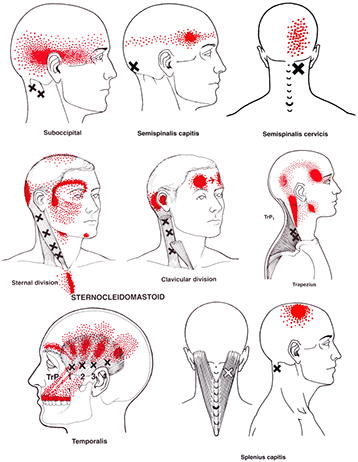
This picture shows some common referral patterns of the neck muscles. The X's are trigger point locations in the muscles and the red areas show where the referral pain (tension headaches) are felt.
Why do people get them?
Neck problems are so prevalent. So many people have poor posture and are so stressed! Also repetitive computer and cell phone use affects posture and causes neck pain and headaches. These headaches are very prevalent and exhausting. They take away from your focus and energy and impact sleep because when you have pain you don't have restorative sleep, which impacts your overall healing.
How do you treat tension headaches?
I have a lot of experience with treating headaches and neck pain because of my work with people who have been in motor vehicle accidents. Many people do not only come in when they have a headache, they come in for prevention and maintenance. Typical treatment would be 1/month to counteract lifestyle factors such as ongoing postural and stress tension. It is also beneficial as time for self care and to help with relaxation. If you are getting more than 3 headaches a year, treatment can help reduce frequency and intensity of your headaches.
Leslie Brown is a Registered Massage Therapist at Norfolk Chiropractic Wellness Centre. To book a massage with Leslie, or chat with Dr. Katie about multidisciplinary headache care call 519 827-0040.
Restorative/Yin Yoga at Fitness Junction
Last night, after tricking my baby into bed a few minutes early, I headed out to the Fitness Junction. I arrived to a softly lit room, and relaxed on my mat supported by blocks and bolsters, under a nice blanket!
Yoga is one of my favourite self-care activities. I always find myself leaving more relaxed in both mind and body. So when Jana at Fitness Junction told be about their Restorative/Yin class designed to help release tension and help sleep I knew I had to try it out for you!
Last night, after tricking my baby into bed a few minutes early, I headed out to the Fitness Junction. I arrived to a softly lit room, and relaxed on my mat supported by blocks and bolsters, under a nice blanket! Renee led the class gently through a series of gentle postures to stretch and relax the body. Even though I had missed the earlier classes in the series, Renee walked me through postures that were new to me without making me feel like I was slowing everyone else down.
When the class ended I could hardly believe it had been a whole hour! I headed home and had a great sleep (although that may have had something to do with my daughter having a pretty good night too). Even though I just popped into one class, one of the other participants told me that the classes really build on each other and she was noticing big changes in her sleep and dreams. If this sounds like something you'd like to try out you can book you class here.
Wishing you great sleep,
Dr. Katie


Essential Oils and Anxiety: Do they WORK and are they SAFE?
Recently, I've been hearing a lot of conflicting information about essential oils. On one hand people seem to be using them liberally as a cure-all for many different ailments. On the other, there are many warnings going around about the dangers of using essential oils and how toxic they are. So what's really going on here? What is an essentail oil? Do they work? And are they safe?
Recently, I've been hearing a lot of conflicting information about essential oils. On one hand people seem to be using them liberally as a cure-all for many different ailments. On the other, there are many warnings going around about the dangers of using essential oils and how toxic they are. So what's really going on here? What is an essential oil? Do they work? And are they safe?
What is an Essential Oil?
An essential oil is a type of plant extract. Chemists use a variety of methods to remove the volatile organic compounds from the plant material. Sometimes these oils are extracted with steam, other methods use chemical solvents to extract the oils. This means that the product is plant based but very potent as it contains only a very particular set of plant constituents.
Why extract the Essential Oil?
Essential oils have been used historically for their potent aromas in a healing modality called aromatherapy. The volatile organic compounds are the molecules of the plant that give it it's smell. Aromatherapy uses the smell of different essential oils for therapeutic benefit. When essential oils are marketed for use in anxiety the oils or blends of oils may include: Lavender, Rose, Bergamot, Chamomile, Orange, and others.
Does Aromatherapy Work for Anxiety?
The evidence for the use of aromatherapy in anxiety is positive. Many trials show a decrease in anxiety symptoms without any adverse effects. At this level of research, aromatherapy is considered a complimentary treatment for anxiety and experts are recommending its use along side other treatments.
Do Essential Oils have benefit beyond Aromatherapy?
Beyond the effects of aromatherapy, some essential oils have been studied for use in other ways. One common use is as a complement to massage therapy. Studies have show increased benefit to mood from aromatherapy massage. Although during an aromatherapy massage individuals would smell the essential oil, when he oil is placed on the skin many compounds are absorbed into the blood stream, creating the opportunity for the oil to act in ways beyond the aromatherapy action.
In addition to topical use, there is ongoing research into the internal use of essential oils for anxiety. There have been positive human trials on lavender essential oil taken as a supplement and animal trials have begun investigating the possible risks and benefits of other essential oils for anxiety.
So what are the risks?
Unlike other herbal preparations such as infusions (teas), essential oils a very concentrated. Aromatherapy may not be an appropriate treatment for individuals with lung disease. Even oils widely considered safe such as lavender oil can cause skin rashes when applied improperly. When taken internally some essential oils are harmful to the liver, kidneys and gastrointestinal tract. Essential oils have caused death with as little as 1 tsp!
When it comes to herbal medicine, in the form of essential oils or otherwise, it's important to remember that each herb (or oil) is different and is associated with its own unique risks. Just because the research shows that lavender oil is beneficial for anxiety does not mean that is appropriate for all people with anxiety or that any essential oil is safe for internal use. When in doubt, talk to your ND or Primary Care Provider.
How do I know if MY essential oil is safe to take internally?
While essential oils for aromatherapy are not strictly regulated, Health Canada strictly regulates natural health products. If your essential oil has been approved by Health Canada for internal use it will have an NPN (natural product number) on the bottle. If there is no NPN it is not approved by Health Canada for internal use. Perhaps obviously, an NPN denotes general safety not safety for a particular individual. Its always best to check with your regulated health care provider before taking a new supplement.
I want know more!
If you have questions about natural treatments for anxiety - give me a call, I'd be happy to chat with you about naturopathic treatment of anxiety.


Taking the Hurrying out of the Holidays
The holiday season can be restful! Check out my my top 5 tips for creating some calm this holiday season!
Holidays can be stressful! All the hustle and bustle. Travel. Family Obligations. It's easy to get overwhelmed in the shoulds and musts of the season and end up back to work in January feeling like you need a holiday from your holiday! But the holiday season can be restful. Here are my top 5 tips for creating some calm this holiday season.
#5 Do Less
Seriously. Just say no to some things. Set aside days where you have nothing planned. This creates space to sit and have a cup of hot chocolate or go for a skate and enjoy the season in an unstructured way.
#4 Focus On Things You Enjoy
What gives you energy? I don't know many people who enjoy cooking AND baking AND home decorating AND letter writing AND iceskating AND whatever other holiday activity it seems like everyone on Pinterest is doing. Pick the activities that give you joy and energy and let the ones you don't enjoy go.
#3 Set Your Boundaries
How much of your holiday time is spent pleasing other people? It's wonderful to spend time with loved ones but when time and traditions become dreaded obligations its time to reconsider what's best for you and set appropriate boundaries.
#2 Keep Up Your Routine
What do you do on a day to day or week to week basis that keeps you on track? It might be meal planning, going to the gym, or just pouring yourself a cup of tea and taking a few minutes to yourself in the evening. Often the holidays have so much going on our routines fall by the wayside in times when we need them the most!
#1 Know What YOU Need
Take some time to reflect. What was good about last year? What wasn't so great? Think about your favourite holidays and ask yourself WHY they were enjoyable.
Feeling like this is easier said than done? Come on out to one of my live holiday workshops in Guelph and get some guidance working through the details. I'm hosting an Advent focused event at Dublin Street United Church and a secular holiday talk at Goodness Me. Did I mention they are free? Hope to see you there!
The Major Men's Health Problem No One Talks About
I know why it gets ignored. It's hard to talk about. It's hard to write blog posts about. For some reason it seems like it's in another place. It's not a tangible like cardiovascular disease and cancer. You don't know which of your friends' dad's have had it. Or at what age your uncle did. And because of this it can seem like it's not a big deal. But the truth is it's common, one in ten Canadian men get it over the course of their life, and it's deadly - disproportionately killing men, one every minute.
If you haven't guessed, I'm talking about depression. Yes one in ten men and if you are doing the math, you know someone even if you don't know who. For some reason we don't talk as much about "mental health" Something that is so confusing to me because from my perspective depression, well all mental health concerns really, aren't just about our minds. In fact, no disease or disorder is "just mental" or "just physical."
Mental Health is inseparable from our physical health. So why don't we talk about it? Sometimes I find men are afraid that identifying the problem means having to hash out all the gory details. LIke acknowledging that there is some shit going on in their life and that it's making everything else a whole lot less fun means having to talk about it in detail. But there are lots of ways to heal from depression and talking is only one component. Sometimes men need to be heard, but sometimes they need to run more, or learn about mindfulness, or spend some time having fun with friends.
This month, in honour of Movember and in support of men's mental health, I'm donating $40 from each men's initial naturopathic visit to The Movember Foundation. If you know of someone going through a hard time right now who might be helped by this article, please share it with them. If that person is you, and you want to talk more about naturopathic support for mental wellness, I'm happy to listen.


On Feeling Overwhelmed: The #1 way to know what you need to feel at peace again
This morning I felt a little off. I didn't sleep well last night and as I prepared to go to work I felt sad and tired, like I'd rather have a day in bed than head into work. It's been a busy few weeks for me. We ran 2 workshops the past 2 Tuesday evenings, I traveled for work over the past weekend, and in general had just put in more hours than usual. This week is looking like more of the same with extra work things booked into hours I usually use to take care of myself and my home.
I took a breath and checked in with myself; I found I was feeling overwhelmed. Knowing I had some time booked off soon, I checked my calendar and discovered I just had to keep this up until... Easter. My face fell and I wanted to cry. I knew I needed some space before then and so I made up my mind - I would take a day off. As soon as the thought of this came into my mind I felt more peaceful.

I arrived at work, checked my schedule and booked off the next available day. I felt a weight lift. To me this is the radical self love I encourage in my work, and work to practice for myself. When you love what you do, it's hard to remember you can't spend all your waking hours working on it. Your mindbody needs rest, and when I didn't schedule enough of it in, my mindbody let me know.
These messages from our bodies are gifts. What is your body telling you? How can you honour its needs today?
Love, Dr. Katie
What You Missed @ The Tranquil Mind Seminar
Last night I had a wonderful time chatting with some great people about stress, anxiety and insomnia management. I know you all really wanted to come so I thought I'd share all the best bit for those of you who live too far away, or couldn't make a 7:30pm talk on a Tuesday!

One topic we spent a bunch of time on was nutrients you might be missing. Did you know that nutritional studies show half of American women were getting less than 75% of the recommended daily amount of magnesium. Magnesium, which is found in vegetables and whole grains, can relieve symptoms of anxiety and insomnia when they are caused by a magnesium deficiency.
Another topic that came up frequently was different types of mindfulness practices. Many people shared their experiences from everything from walking in natures, to exercise, to meditation. We discussed how the practice of being present can ease anxiety and bring more enjoyment to life by allowing your consciousness to surrender to what's happening in the moment.
Thank you to everyone who came out and shared last night!
Still feeling like you missed out? Book your calendars for Tuesday November 17th, 7:30pm @ Norfolk Chiropractic Wellness Centre in Guelph because I'm running this talk one more time this year! See you there!
Dr. Katie
Live: Spend Less Time Worrying and More Time Living Your Passions
If you are reading this blog than I'm away from my office right now. That's right, vacation, I'm in my first year being self employed and I'm away right now, catching up on beach time, book reading, playing with the neiphlings and probably sampling some county wine. So why am I telling you this? Because planning to take vacation, and then actually taking the vacation is, how I want to live.

Just liking guiding people through stressful life periods is a passion of mine, I'm also passionate about spending time with my family. By getting to know myself and connect with my higher self and what I want from life it lets me create almost like a mission statement. When you are connected with your passion you can live your life with purpose and design your life around living your dreams.
I'll share another secret with you today. I'm not writing this post from the beach. In fact, I wrote it 2 weeks ago from my office. Why? So I could be in the moment right now when I'm away from work. For my life, work/life harmony means being where I am and practice being present in what I'm doing. This mindfulness practice increases productivity and lets you focus on where you are while breaking the worry cycle of thinking about places you aren't and things you can't deal with in the moment.
So what's with all the honesty today? Why share so much? Because expressing what's going on for me, acknowledging emotions, brings me piece of mind. Being able to speak your truth, wether literally through tea with a friend or written into a journal, or figuratively by creating or appreciating art or music, sets those emotions free.
Follow your passion. Live in the moment. Speak your Truth.
Love, Dr. Katie
Nourish: What Your Body Needs to Feel Calm and Focused
We've all heard the saying "you are what you eat" but it is so true, especially when it comes to mental health and whole body wellness. If your body isn't getting what it needs, it freaks out, leaving you tired stressed and more emotional than is really you.
So what can be done? Here are my top 3 ways you can nourish your body to help you feel calm.
1. Balance Your Blood Sugar. Not just for diabetics, blood sugar regulation is important for everyone! Think of the last time you saw a bunch of kids at a birthday party with cake. They have all this energy and then crash! Meltdowns! Moods all over the map! The same things happen to us as adults! When you eat crap your blood sugar goes on a roller-coaster ride and takes your emotions along for fun! So what can you do? In general, most people feel less anxious eating less carbohydrates and sugars and increasing their fruits, vegetables, fats and proteins. It doesn't mean you can never eat cake (although you might want to check out this recipe). It's about shifting the balance away from things that wire you up towards things that keep you calm.
2. Replenish Nutrients. A standard north american diet can be deficient in many nutrients. Minerals are removed from our foods through the refining process and that leaves many people deficient in minerals. One to watch for is magnesium, which deficiency of manifests as anxiety in some people. Omega-3 fatty acids is another nutrient in which the modern diet does not have enough in. Try switching from meat to fish or seafood 2 nights a week. The last "nutrient" is a bit outside the usual definition but we traditionally got it from our foods, probiotics. Due to the wonders of refrigeration we eat way less fermented foods than our traditional diets and with the advent of processed foods we are eating less fibre (food for our good microbes) and more preservatives (things that kill microbes). The relationship between our microflora and our mood is emerging and restoring these beneficial bacteria can be the key to wellness in all kinds of disorders, including anxiety.
3. Movement. We all know exercise is good for us but so many of us don't spend enough time moving. I know when I'm stressed I need to move even more, but that's often when I feel like it least. A friend recently said to me "when I don't feel like going to the gym, that's when I know I have to go." What they have discovered, along with may other people who use exercise as their medicine of choice for mental health maintenance, is how powerfully uplifting is to be moving in your body.

When we feel stressed and anxious, when we are tired because we didn't' sleep, it's easy to go with the "treat" mentality. I deserve this chocolate bar. I need this coffee. I'm too tired to go to yoga, I'll watch TV instead. I know I've said each of those things at some point or another. But in those moments when we are tired/stressed/anxious what we need most is to nourish ourselves. So go for a walk, make yourself a salad for dinner and throw a piece of fish on it. Your brain will thank you.
Love, Dr. Katie
Relieve: How Natural Therapies Can Help Manage Stress In the Moment and Over Time
I can't tell you the number of times someone has come into my office with a concern and asked me "is this all in my head" "do you think I'm making this up" or exclaimed "maybe I have a chemical imbalance" or "I think this is my hormones" A lot of the time there seems to be this either/or mentality. Either this is all in my head, or my head is fine it's my body that's got a problem with it. I tell everyone the same thing. It's not either/or, it's both.
Our thoughts and emotions exist in our bodies as molecules. They create and shape or physiology just as our physiology creates and shapes our thoughts and emotions.
That's all well and good Dr. Katie but what do I DO about this?

Naturopathic Support for stress and anxiety looks at both the mind and the body together and supports you both in the moment and over time. Therapies are combinations of things you do (like breathing, exercise, changing how you eat and self care) and things that you take (such as teas, nutritional and botanical supplements and homeopathic remedies.)
Want to get started now? Check out my tree meditation and feel calmer in 3 minutes.
Love,
Dr. Katie
New Program for Stress, Anxiety and Insomnia
It's here! You may or may not know but behind the scenes I've been working hard to curate the best resources in naturopathic stress and anxiety management. What's it's become is an exciting clinical program that puts you in the drivers seat of your own mental health and wellbeing. Tranquil Minds is about getting to know yourself on a deeper level. It's about finding a sense of purpose in life. It's about taking care of your self mentally and physically. It's about providing you with the information you need to make yourself feel better.

Designed by Evan Woolfery
This program is my passion and I LOVE to talk about it. So if you're in the Guelph area and you want to find out if this is the right fit for you call me @ 519 827-0902 or email info@norfolkwellness.com to book a free 15 minute chat about whether Tranquil Minds is a good fit for you.
Tree Meditation: Feel Calmer in 3 minutes
Feeling overwhelmed? I know I get that way sometimes, which is why I wanted to share my favourite grounding meditation with you. I call it the "Tree Meditation" because it uses the metaphor of a tree to help you connect with the earth and feel grounded and stable. Let me know if you like it!
Top 5 Natural First Aid Kit Must Haves
Summer is a busy time. Many of us use the warm weather to spend more time outdoors having fun and being active. But sometimes we fall and scrape our knees in the pursuit of fun. Or get a bit of a sunburn because we were having way to much fun to think about reapplying our sunscreen. Or withstand the odd mosquito bite to enjoy a glass of iced tea on the deck/dock/patio. So here is a list of what you can throw together to treat most minor injuries whether your on your deck or visiting a cottage!
- Calendula Salve. Summers are filled with skinned knees and BBQ burns. Calendula can help heal any minor skin injury. It's important to only use calendula topically and not on deep cuts or open wounds.
- Homeopathic Arnica. Arnica is your magic bullet for minor bumps, bruises, and falls. Anything that is going to bruise could use a quick dose (2 pellets) or homeopathic arnica under the tongue. Anyone claiming "I'm OK" or "Don't touch me!" after a fall is a great candidate for homeopathic arnica.
- Electrolyte Replacement. So you spent a little to long in the sun (and maybe had a drink or two while you were out there)? No problem, electrolytes are your friend. Grab a glass of water and mix in some emergen-C/Ester-C/other similar nutrient drink package. Feeling up for a challenge - make an electrolyte replacement drink from scratch!
- Tea Tree Essential Oil. This antimicrobial essential oil is great for skin rashes. It can help relieve bug bites and used in a carrier oil or mixed with water, and witch hazel, can be used as a mild bug spray. Remember Tea Tree oil is strong and can be quite drying on skin.
- Coconut Oil. The myths are mostly true, coconut oil does a lot of things for your body. It's moisturizing capabilities help soothe sunburns and other wounds. It has mild antimicrobial properties that combat rashes and its even mildly sun protective (not enough to go without sunscreen though).
So there you go! 5 things to get your first aid kit ready this summer! Want more natural first aid tips? Come out to my Free Natural First Aid Seminar this Tuesday June 9th @ Norfolk Chiropractic Wellness Centre @ 7pm. Spots are limited so reserve yours today by calling 519-827-0040 or emailing info@norfolkwellness.com